
At a glance
- Term: Spring 2027
- Program dates: February 4 to June 4, 2027
- Location: Athens, Greece
- Language: English
- Academic load: Five courses, 30 ECTS
- Credit: Typically evaluated as 15 U.S. semester credits
- Housing: Furnished and equipped shared apartments in central Athens
- Program fee: $18,500 USD, including tuition and housing
- Application deadline: November 1, 2026, or earlier if the program reaches capacity
Housing, tuition, program excursions, insurance, and core student support are included. International airfare and most meals are not included.
Plan your five-course semester with confidence
Choose five courses from a focused 13-course menu spanning brain and behavior, mental health, research methods, social psychology, human development, culture, ethics, and justice. The suggested pathways below are planning guides, not fixed tracks.
Before registration, send your five preferred courses and backup choices. We will review prerequisites and timetable compatibility with you. Your home institution decides how completed courses apply to your degree, and Global Semesters can provide the course outlines, ECTS information, academic calendar, and transcript details needed for approval.
Suggested pathways
Brain, Behavior & Mental Health
Explore how biological systems, development, and social context influence behavior and psychological well-being. A strong option for students interested in biological psychology, mental health, health sciences, or research.
- PSY-230A Brain and Behavior
- PSY-240 Abnormal Psychology
- BIOL-115 Introduction to Human Physiology
- PSY-195 Research Methods and Statistics II
- PHIL-120 Ethics
Students who have completed the required introductory sequence may choose PSY-145 Research Methods & Statistics I instead of PSY-195 when that better fits their preparation.
Society, Culture & Justice
Study behavior in social and cultural settings, from identity and group influence to ethics, development, and the legal system. A strong option for social psychology, criminal justice, sociology, anthropology, public policy, or law.
- PSY-210 Social Psychology
- PSY-332 Forensic Psychology
- ANTH-105A Cultural Anthropology
- PHIL-120 Ethics
- PSY-220A Child and Adolescent Development
Human Development & Social Behavior
Examine how people develop, learn, form relationships, and respond to their social and cultural environments. A strong option for students interested in development, education, family studies, youth services, or community work.
- PSY-220A Child and Adolescent Development
- PSY-210 Social Psychology
- PSY-111 General Psychology II
- BIOL-115 Introduction to Human Physiology
- ANTH-105A Cultural Anthropology
PSY-110 General Psychology I, PSY-145 Research Methods & Statistics I, and DES-260 Photography I offer additional ways to build foundations, strengthen research skills, or add a visual communication elective.
Courses
Every course carries 6 ECTS and is taught in English. Thirty ECTS is typically evaluated as 15 U.S. semester credits. Your home institution makes the final decision about transfer credit and degree application.
PSY-110 General Psychology I
Build a foundation in psychology through learning, motivation, emotion, intelligence, personality, social behavior, psychological disorders, and treatment. Preparation: No previous psychology course is normally required. Credit: 6 ECTS. Download Official Course Outline
PSY-111 General Psychology II
Continue the introductory sequence through research methods, biological bases of behavior, perception, consciousness, memory, language, cognition, lifespan development, health psychology, and everyday applications. Preparation: PSY-110 General Psychology I or an approved equivalent is recommended. Credit: 6 ECTS. Download Official Course Outline
PSY-145 Research Methods & Statistics I
Learn how psychologists turn questions into evidence through qualitative and quantitative methods, research design, sampling, questionnaires, ethics, foundational statistics, and APA-style reporting. Preparation: An introductory psychology sequence equivalent to PSY-110 and PSY-111 is normally expected. Credit: 6 ECTS. Download Official Course Outline
PSY-195 Research Methods and Statistics II
Advance your ability to select, apply, and interpret statistical methods used in psychological research, including chi-square, correlation, t-tests, analysis of variance, regression, statistical software, and APA-style reporting. Preparation: PSY-145 Research Methods & Statistics I or an approved equivalent is normally required. Credit: 6 ECTS. Download Official Course Outline
PSY-210 Social Psychology
Examine how people think about, influence, and relate to one another through social judgment, attitudes, persuasion, conformity, groups, culture, prejudice, aggression, attraction, and prosocial behavior. Preparation: An introductory psychology sequence equivalent to PSY-110 and PSY-111 is normally expected. Credit: 6 ECTS. Download Official Course Outline
PSY-220A Child and Adolescent Development
Study physical, cognitive, emotional, and social development from infancy through adolescence. Compare developmental theories and consider the influence of families, peers, schools, culture, and wider social conditions. Preparation: PSY-110 General Psychology I or an approved equivalent is normally expected. Credit: 6 ECTS. Download Official Course Outline
PSY-230A Brain and Behavior
Explore the biological foundations of behavior through neuroanatomy, neural communication, brain development and plasticity, sensory systems, sleep, motivation, and core functions of the nervous system. Preparation: An introductory psychology sequence and introductory biology course are normally expected. Credit: 6 ECTS. Download Official Course Outline
PSY-240 Abnormal Psychology
Study psychological disorders through contemporary biological, psychological, and social perspectives. Examine classification, assessment, contributing factors, lived experience, and evidence-based approaches to intervention with attention to culture, context, and stigma. Preparation: An introductory psychology sequence equivalent to PSY-110 and PSY-111 is normally expected. Credit: 6 ECTS. Download Official Course Outline
PSY-332 Forensic Psychology
Apply psychological evidence to legal and criminal justice settings. Topics include investigative interviewing, eyewitness testimony, false confessions, jury decision-making, offender profiling, and risk assessment. Preparation: No formal prerequisite is normally listed; previous psychology study is recommended. Credit: 6 ECTS. Download Official Course Outline
BIOL-115 Introduction to Human Physiology
Develop an integrated understanding of how the human body functions, with particular relevance to the nervous, endocrine, and sensory processes that support behavior and health. Preparation: No formal prerequisite is normally required. Credit: 6 ECTS. Download Official Course Outline
PHIL-120 Ethics
Develop a practical framework for difficult moral questions through relativism, social contract theory, utilitarianism, Kantian ethics, feminist ethics, and virtue ethics. Preparation: No formal prerequisite is normally required. Credit: 6 ECTS. Download Official Course Outline
ANTH-105A Cultural Anthropology
Explore cultural diversity through comparative and ethnographic perspectives on identity, kinship, belief and ritual, gender, ethnicity, social organization, fieldwork, and research ethics. Preparation: No formal prerequisite is normally required. Credit: 6 ECTS. Download Official Course Outline
DES-260 Photography I
Learn photography through camera operation, exposure, composition, lighting, editing, critique, and visual research. Projects develop close observation and visual communication. Preparation: No formal prerequisite is normally required. Credit: 6 ECTS. Download Official Course Outline
Psychology Research Experience
Alongside your course schedule, the Psychology Research Experience offers a structured, faculty-guided opportunity to investigate a behavioral or psychosocial question. Students frame a question, plan an appropriate study, consider research ethics, work with structured response data, and communicate their findings in an academic poster.
The exact methods reflect the project and each student’s previous preparation. The work is designed to strengthen the skills that sit behind later coursework: defining a manageable question, distinguishing evidence from assumption, interpreting results carefully, and explaining limitations as well as findings. Students complete the work with faculty guidance and present it in a format they can discuss with advisers, faculty members, and future employers or graduate programs.
This is an undergraduate academic and research experience. It does not include clinical diagnosis, treatment, therapy hours, patient care, medical training, or neuroimaging training.

Credit approval and transcript
The University of Nicosia uses the European Credit Transfer and Accumulation System. Each course carries 6 ECTS, and five courses total 30 ECTS. An official University of Nicosia transcript is issued for successfully completed courses.
For approval before departure, ask your academic or study abroad adviser to review your preferred courses and backup choices. Use the official course-outline links above for course approval. Global Semesters can also provide course descriptions, ECTS information, the academic calendar, and transcript details.
Students should seek written home-institution approval before departure, particularly when a course is intended to satisfy a major, minor, prerequisite, general education, or financial-aid requirement. Taking this step early gives you more room to adjust if a preferred combination cannot be confirmed during registration.
Excursions
Excursions & Learning Beyond the Classroom
Throughout the semester, students take part in a thoughtfully designed set of excursions in Athens and beyond that complement coursework and introduce them to Greece’s landscapes, communities, and cultural traditions. These experiences balance guided exploration with time for independent discovery, helping students understand Greece not only through its history, but through everyday life.
Athens & Its Surroundings
Students explore Athens as both an ancient city and a modern capital through visits to some of its most significant sites and neighborhoods. Walking tours and guided experiences may include the Acropolis, the Ancient Agora, Thisseio, the Panathenaic Stadium, and the historic areas of Plaka and Monastiraki. Together, these spaces reveal how ancient foundations continue to shape public life, politics, and urban culture in contemporary Athens.
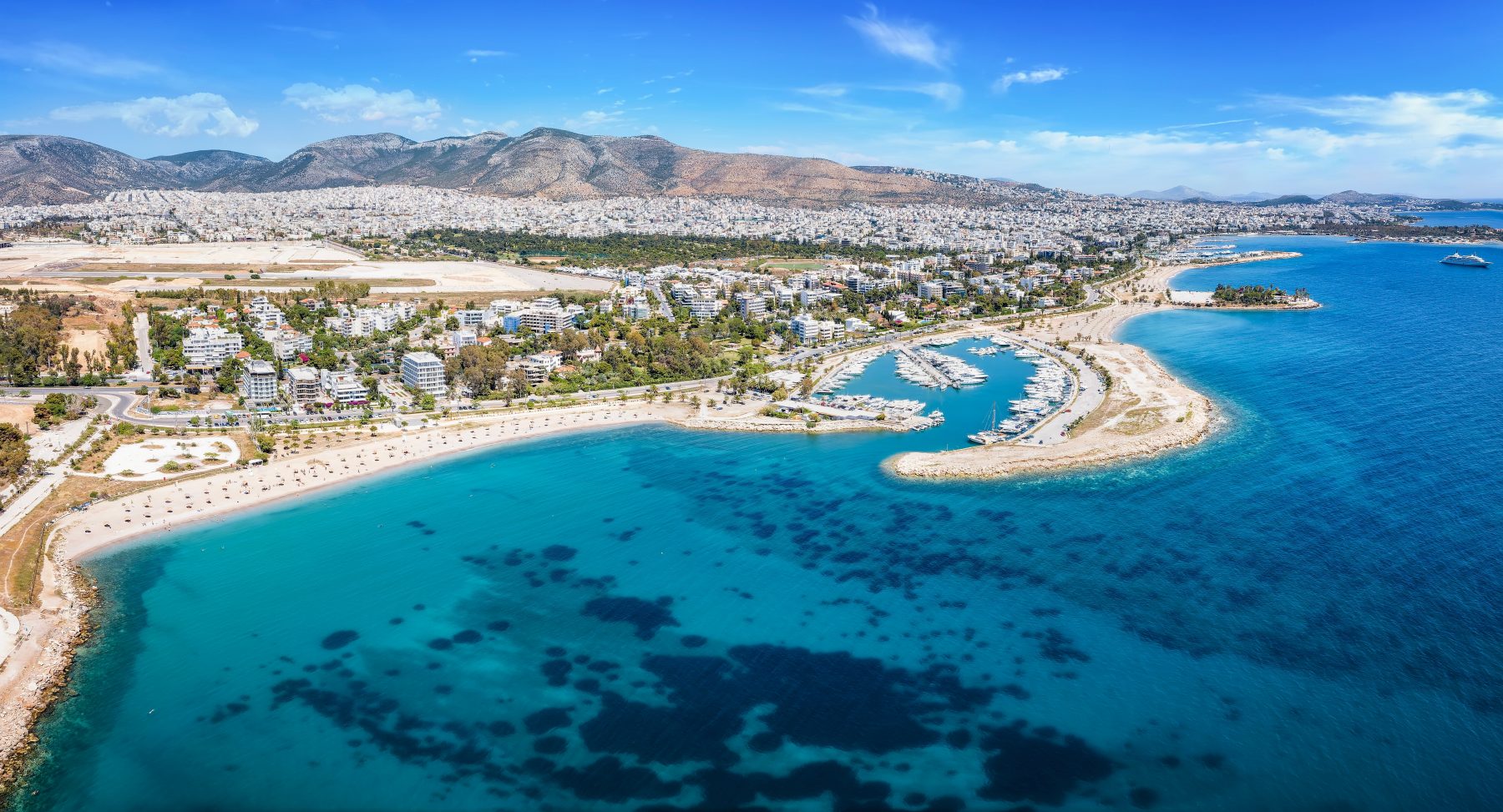
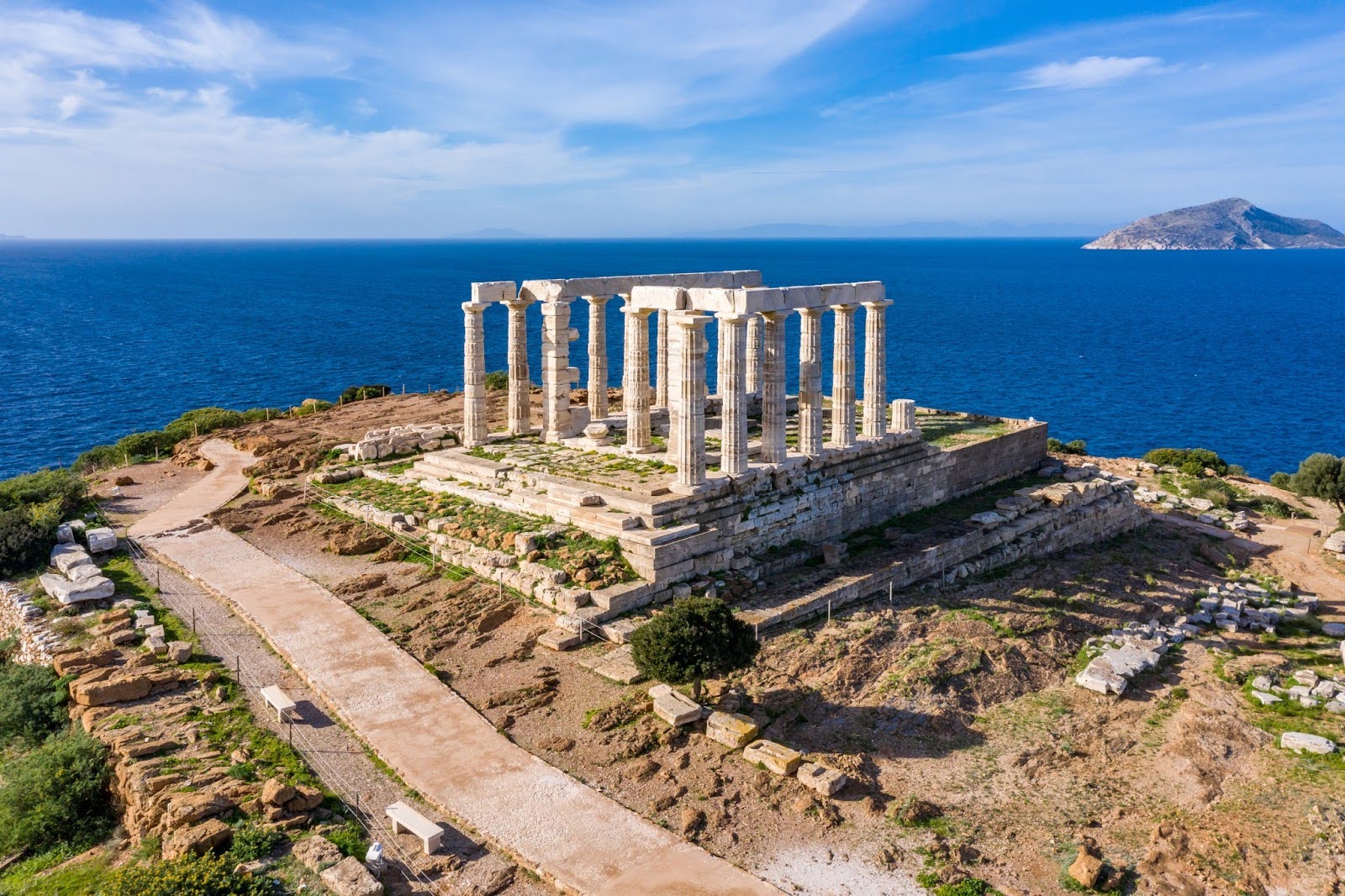
Excursions beyond the city center introduce students to the coastal landscape that defines life in southern Greece. Visits to Glyfada and Vouliagmeni highlight the role of leisure, recreation, and the sea in modern Greek culture. A trip to Cape Sounion, home to the Temple of Poseidon, connects dramatic natural scenery with ancient mythology and religious practice.
Island Experiences
Greece’s islands are synonymous with the country itself, shaping how people move, work, and build community across the Aegean. Island excursions offer students insight into how geography influences daily life in coastal and island settings through transportation networks, commerce, and social interaction. Traveling by ferry, navigating compact towns, and spending time in active harbors allow students to experience the rhythms of island life firsthand.
Visits may include nearby Saronic Gulf islands, where working ports, walkable towns, and strong local traditions provide an accessible introduction to island culture. Depending on the itinerary, students might explore places such as Aegina or Hydra as examples of island communities with deep historical roots and distinct relationships to the sea, from archaeological, religious and cultural sites to maritime heritage and everyday life shaped by a harbor economy.
Destinations and length of stay may vary, but these visits often highlight the connections between maritime trade, cultural tradition, artistic production, and contemporary tourism, alongside the built environment of lively town centers and coastal settings. These experiences link close observation of place with the cultural and historical themes students are exploring throughout their study abroad experience.
Finalized itineraries are posted closer to program start date. Please note that itineraries are subject to change without notice.
Mainland Excursions
Mainland trips complement island experiences by highlighting Greece’s regional diversity and layered past. A visit to Nafplio, one of Greece’s most picturesque coastal towns, allows students to explore a living historic center influenced by ancient, medieval, and modern periods. Nearby, students may visit Epidaurus, home to one of the best-preserved ancient theaters in Greece and a powerful example of ancient design, performance, and public space.
Together, these excursions give students a well-rounded understanding of Greece, linking iconic historical sites with modern communities and everyday life. For many students, these shared experiences become some of the most memorable and meaningful parts of the semester.
For overnight excursions, students typically stay in double occupancy hotel rooms.



* Indicative itinerary, subject to change. Some trips may not be possible due to Government regulations.
Dates, deadlines, and visa information
Spring 2027
| Milestone | Date |
|---|---|
| Semester dates | February 4 to June 4, 2027 |
| Application deadline | November 1, 2026 |
| Non-refundable Confirmation Deposit deadline | November 1, 2026 |
| Final payment deadline | November 15, 2026 |
| Final withdrawal deadline | November 15, 2026 |
Spring 2027 Early Confirmation Deposit discounts
- $500 discount: Submit the non-refundable Confirmation Deposit by September 30, 2026.
- $250 discount: Submit the non-refundable Confirmation Deposit after September 30 and by October 15, 2026.
Visa information
Spring 2027 exceeds 90 days. Students traveling on U.S. passports will need a Greek national Type D student visa. Global Semesters provides supporting acceptance and enrollment documentation, but each student is responsible for obtaining required documents, requesting and attending the appropriate consular appointment, submitting a complete application, paying required fees, and securing the visa before travel.
| Milestone | Target |
|---|---|
| Application deadline | November 1, 2026 |
| Non-refundable Confirmation Deposit | November 1, 2026 |
| Final payment deadline | November 15, 2026 |
Review official Greek visa information for U.S. applicants
Global Semesters is not responsible for information provided on external links.
Student Responsibilities
- Students are responsible for obtaining all required documentation for travel related to their participation in a Global Semesters study abroad program
- Global Semesters bears no responsibility for students who are unable to obtain or do not have valid passports or appropriate visas or other documentation in order to attend their study abroad program
Information is current as of August 2, 2026. Withdrawal and refund terms are separate from the final payment deadline and are governed by the Global Semesters Payment Policies.
Fall 2027
| Milestone | Date |
|---|---|
| Program dates | Mid-September to mid-December 2027; planned 89-day program |
| Application deadline | May 1, 2027, or earlier if the program reaches capacity |
| Non-refundable Confirmation Deposit deadline | May 1, 2027, or earlier if the program reaches capacity |
| Final payment deadline | June 15, 2027 |
| Final withdrawal deadline | June 15, 2027 |
Fall 2027 Early Confirmation Deposit discounts
- $500 discount: Submit the non-refundable Confirmation Deposit by January 15, 2027.
- $250 discount: Submit the non-refundable Confirmation Deposit after January 15 and by March 15, 2027.
Visa information
Fall 2027 is planned for 89 days. U.S. citizens can normally participate without a Greek national student visa under the Schengen 90-days-in-180 rule. Time spent elsewhere in the Schengen Area before, during, or after the program also counts. Requirements depend on nationality, passport, residence, and travel history, and Greek authorities make the final determination.
Program fees
Spring 2027 Founding Cohort Program Fee: $18,500 USD
One published fee covers tuition, housing, insurance, program travel and activities, and student support. International airfare, meals, personal local transit or personal travel, books, mobile service, and personal spending are separate.
Included in the fee
- Tuition and university registration for five courses, totaling 30 ECTS
- Official University of Nicosia transcript
- Furnished and equipped shared housing in central Athens
- Airport pickup on the designated group arrival date
- Athens Metro Pass
- Pre-departure guidance and on-site orientation
- Psychology Research Experience and required program research access
- Welcome and local cultural activities
- Included cultural activities and in-country excursions
- Global Semesters staff support on included excursions
- On-site Global Semesters staff and 24/7 emergency support
- Medical, evacuation, and repatriation insurance*
- Use of a Global Semesters mobile phone handset or local SIM or e-SIM; call and data charges are not included
- Academic advising, administration, and visa-document support
*for those institutions opting-in to Global Semesters provided insurance coverage
Fall 2027 Program Fee: $18,500
The $18,500 program fee and separate $200 mandatory program insurance fee total $18,700 before any eligible early-deposit discount. The confirmation deposit stated in an admission offer is applied toward the program fee and secures a place while space remains available.
Sample budgets
Housing and support
Students live with other program participants in fully furnished and equipped shared apartments in central Athens. Apartments are selected for access to metro stations, and UNIC Athens is next to Elliniko metro station. Apartment size, bedroom occupancy, layout, and amenities vary by placement. Detailed placement information is provided before arrival.
Housing includes an equipped kitchen and shared living areas. The exact apartment configuration, bedroom occupancy, amenities, and commute vary by assignment. The standard fee covers shared housing. Global Semesters makes housing and roommate assignments before arrival. Roommate requests are considered when possible but cannot be guaranteed.
Global Semesters supports students through preparation, arrival, university life, housing, included travel, and unexpected situations abroad. On the designated arrival date, students receive airport pickup and help beginning life in Athens. Orientation covers the university, local expectations, public transportation, and emergency procedures. Students receive pre-departure advising, in-country orientation, on-site support, staff support on program excursions, access to UNIC Athens student resources, and a 24/7 emergency support.
UNIC Athens and the city
Study at UNIC Athens, the University of Nicosia campus in Elliniko. The UNIC Athens building at The Ellinikon integrates advanced teaching, clinical simulation and laboratory facilities with UNIC Evolve’s AI, biotechnology and human-health research infrastructure. Elliniko metro station provides a direct metro connection between campus and central Athens.
The Times Higher Education World University Rankings by Subject 2026 place the University of Nicosia in the 301-400 band worldwide and 86th in the European Union for Psychology. These are University of Nicosia rankings, not Athens-campus-specific rankings. Read the University of Nicosia Psychology ranking announcement.
Athens gives academic work a lived context. Cultural anthropology invites close attention to identity, community, ritual, and everyday life. Photography develops observation and visual storytelling in neighborhoods, markets, public spaces, and along the coast. Ethics, social psychology, and human development gain new questions through encounters with a modern European capital shaped by migration, tourism, family life, public debate, and change.
The included cultural program may include a city orientation, survival Greek, guided visits in historic Athens, coastal experiences, and excursions beyond the capital. The final itinerary is shared closer to departure. Destinations, sequence, and visit length may change because of weather, access, or local conditions.
Eligibility and application
You can apply if you are currently attending a college or university, have at least a 2.5 cumulative GPA, will complete at least 30 academic credits before the program begins, and will be at least 18 years old by the program start date. Meeting the minimum requirements does not guarantee admission. Course registration also depends on prerequisites, timetable compatibility, capacity, and academic review.
- Review the course descriptions and download the official outlines linked above.
- Discuss course approval with your home institution.
- Submit your application and requested supporting documents by November 1, 2026 for visa-priority review. Applications received from November 2 through November 15, 2026 are considered only on a space-available and visa-contingent basis.
- If admitted, submit the confirmation deposit by the stated deadline to secure your place.
- Receive travel, housing, orientation, and visa-document guidance before departure.
Spring 2027 exceeds 90 days. Students traveling on U.S. passports will need a Greek national Type D student visa. Global Semesters provides supporting acceptance and enrollment documentation, but each student is responsible for obtaining required documents, requesting and attending the appropriate consular appointment, submitting a complete application, paying required fees, and securing the visa before travel.
Fall 2027 is planned for 89 days, so U.S. citizens can normally participate without a Greek national student visa under the Schengen 90-days-in-180 rule. Time spent elsewhere in the Schengen Area also counts. Requirements depend on nationality, passport, residence, and travel history, and Greek authorities make the final determination.
Questions students and families ask
Do I need to be a psychology major?
No. The program also suits students in behavioral science, neuroscience, human development, health sciences, criminal justice, sociology, anthropology, education, and related fields. Course prerequisites still apply.
Are all courses taught in English?
Yes. All 13 courses in the Spring 2027 program menu are taught in English.
What if I do not meet a prerequisite or my preferred courses overlap?
Send backup choices with your preferred schedule. We will review your academic preparation and timetable, then help you identify an appropriate alternative from the Spring 2027 menu.
Is this a clinical placement or neuroscience program?
No. It is an undergraduate academic and research experience. It does not provide clinical practice, patient contact, diagnosis, treatment, therapy hours, professional licensure, medical training, or neuroimaging training.
What is included in the $18,500 fee?
The fee includes tuition, registration, shared housing, designated-arrival airport pickup, orientation, cultural activities, included excursions, on-site support, insurance for institutions opting in to Global Semesters-provided coverage, and an official transcript. Airfare, meals, personal local transit or personal travel, books, mobile service, and personal spending are not included.
Where will I live?
You will live in a furnished and equipped shared apartment in central Athens with other program students. Assignments depend on available housing.
How do I get to campus?
Apartments are selected for access to public transportation. UNIC Athens is next to Elliniko metro station. Exact travel time depends on the assigned apartment and route.
Are meals included?
Most meals are not included. Welcome and farewell dinners are included, and some program activities may include food.
Is airport pickup included?
Yes, at designated group-arrival times. Students arriving outside those times will pay for separate transportation that will be arranged for them by Global Semesters.
Can I use financial aid?
Financial aid policies differ by home institution. Speak with your study abroad and financial aid offices early. Global Semesters can provide program cost, billing, and academic documentation for that conversation.
When should I apply?
For Spring 2027, apply by November 1, 2026 for visa-priority processing. Applications received from November 2 through November 15, 2026 are considered only on a space-available and visa-contingent basis. The Fall 2027 application deadline is May 1, 2027, or earlier if the program reaches capacity.
Do I need a visa?
Spring 2027 exceeds 90 days. Students traveling on U.S. passports will need a Greek national Type D student visa. Global Semesters provides supporting acceptance and enrollment documentation, but each student is responsible for obtaining required documents, requesting and attending the appropriate consular appointment, submitting a complete application, paying required fees, and securing the visa before travel.
Fall 2027 is planned for 89 days, so U.S. citizens can normally participate without a Greek national student visa under the Schengen 90-days-in-180 rule. Time spent elsewhere in the Schengen Area also counts. Requirements depend on nationality, passport, residence, and travel history, and Greek authorities make the final determination.
For parents and advisers
For parents and families
Review the program fee, sample budget, housing information, insurance, support, and application dates with your student. Our team can answer practical questions about arrival, housing, program travel, and support in Athens.
For academic and study abroad advisers
Use the direct course-outline links above, and request ECTS information, the academic calendar, or University of Nicosia transcript details if your approval process requires them. We recommend reviewing more than five courses so students retain options if a first-choice combination cannot be confirmed.
Make Athens part of your psychology degree
Take five courses in English, complete a faculty-guided behavioral research project, and spend Spring 2027 living in Athens. Connect psychology coursework with applied research in a city shaped by history, culture, and contemporary life.
Questions? Email admissions@globalsemesters.com or call +1 212 321 0921.


